
The complete guide
Choosing a Double Sided RC Stunt Car for Kids
The problem with most first RC cars
Buy a child their first remote control car and you can usually predict how the afternoon goes. Ten minutes of delight, then a bump at speed, then the car on its roof with the wheels spinning uselessly. Someone gets up, walks over, turns it the right way round, hands it back. Two minutes later the same thing happens again.
That cycle is why a lot of cheap RC cars end up in the cupboard by the second week. The driving is fun. The fetching is not. And for a six or seven year old who is still learning how much throttle is too much, the fetching happens constantly.
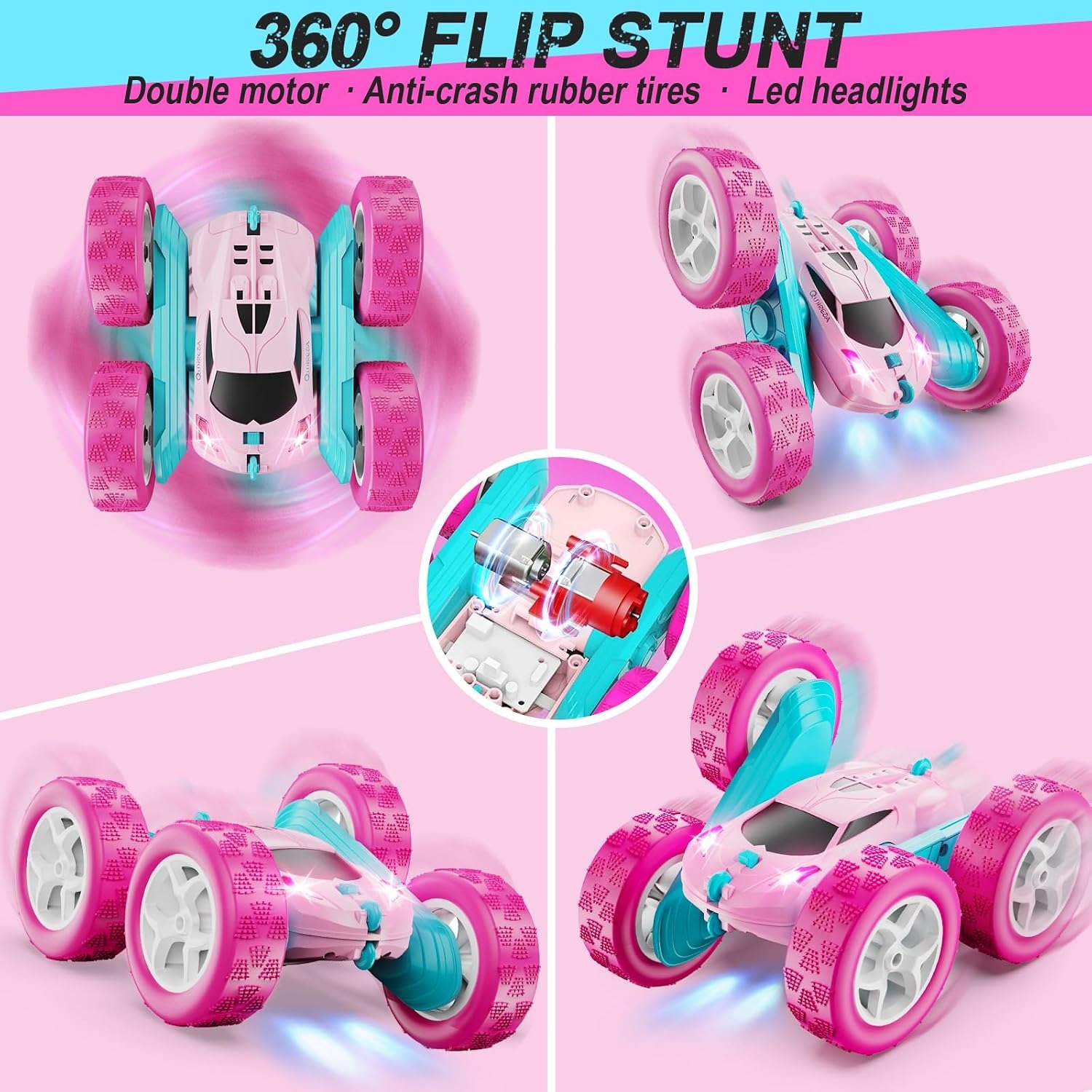
A double sided stunt car fixes this in the simplest way possible. The body is symmetrical top to bottom, and the wheels stick out far enough on both sides that whichever face lands down, the car can still drive. Flip it on a jump and it keeps going. Roll it into a table leg and it carries on from wherever it stopped. The child never has to put the controller down.
How this one works
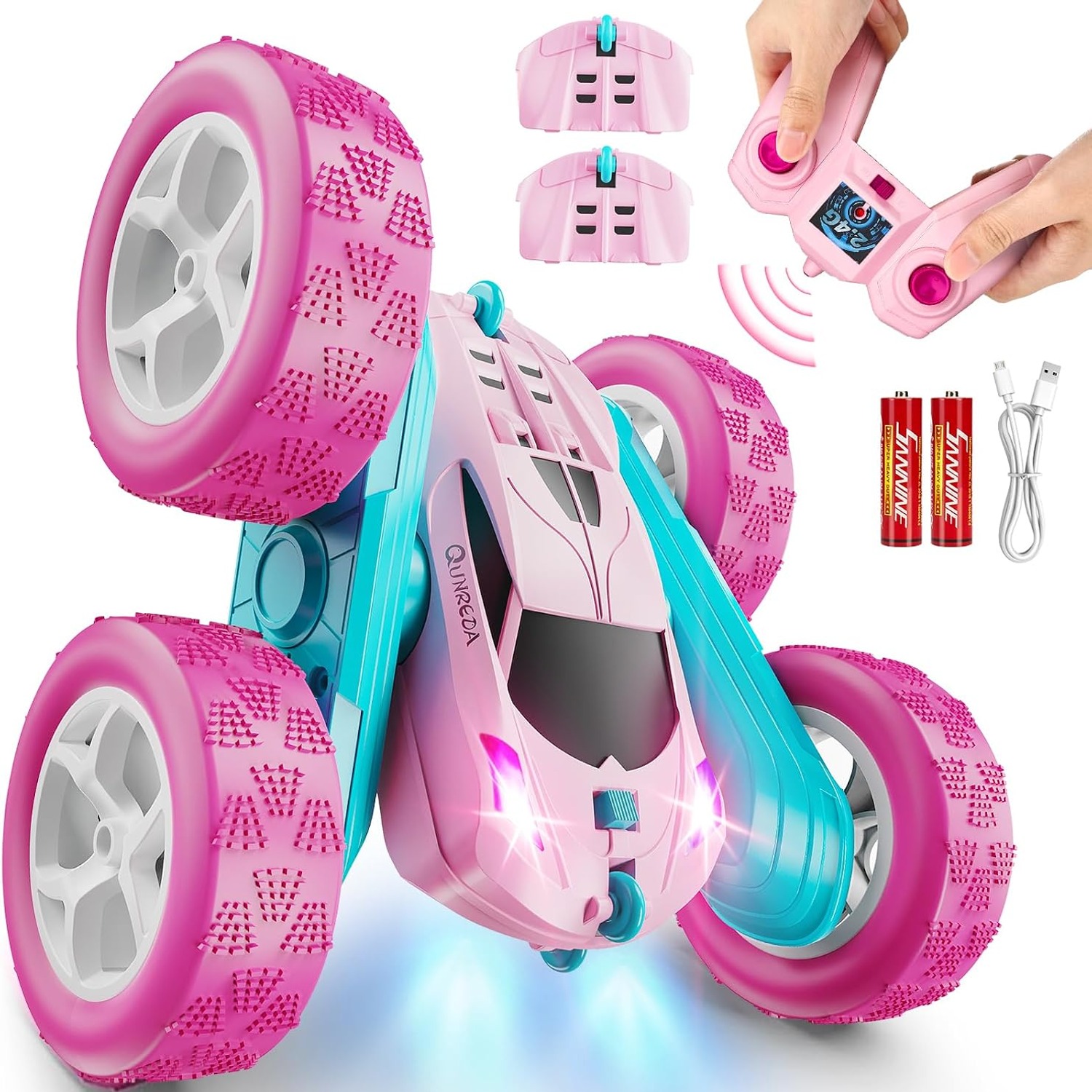
The QUNREDA Q1 is built around that idea, with a pink two-tone ABS body, four chunky wheels and two red LED lights in the nose. Those lights are not decoration. When a car can drive either way up and spin on the spot, knowing which end is the front stops being obvious, and a pair of glowing eyes solves that instantly.
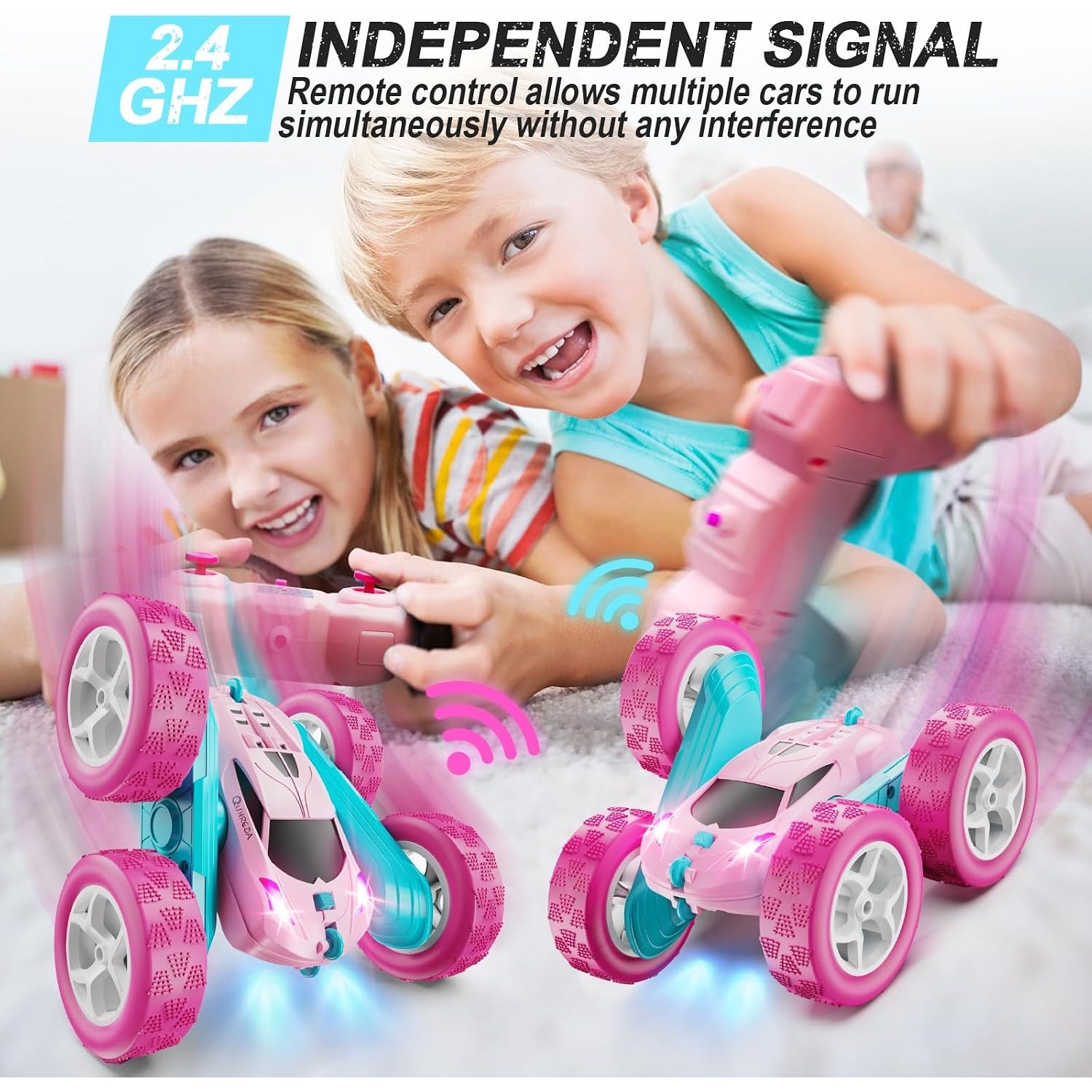
Control is handled by a 2.4GHz radio link with anti-interference built in, and it works out to about 50 metres. Range matters less than most listings suggest, because a car this size is hard to see clearly at 50 metres anyway. What matters more is the anti-interference part. It means two or three of these can run in the same garden without one child's steering hijacking another's car. If you have siblings or a birthday party, that is the feature that gets used.
Top speed is 10 km/h. On paper that sounds modest. On a kitchen floor it is plenty, and for a beginner it is about right. Fast enough to feel exciting, slow enough that the car is still recoverable when a corner comes up quicker than expected.
Two buttons, nine moves
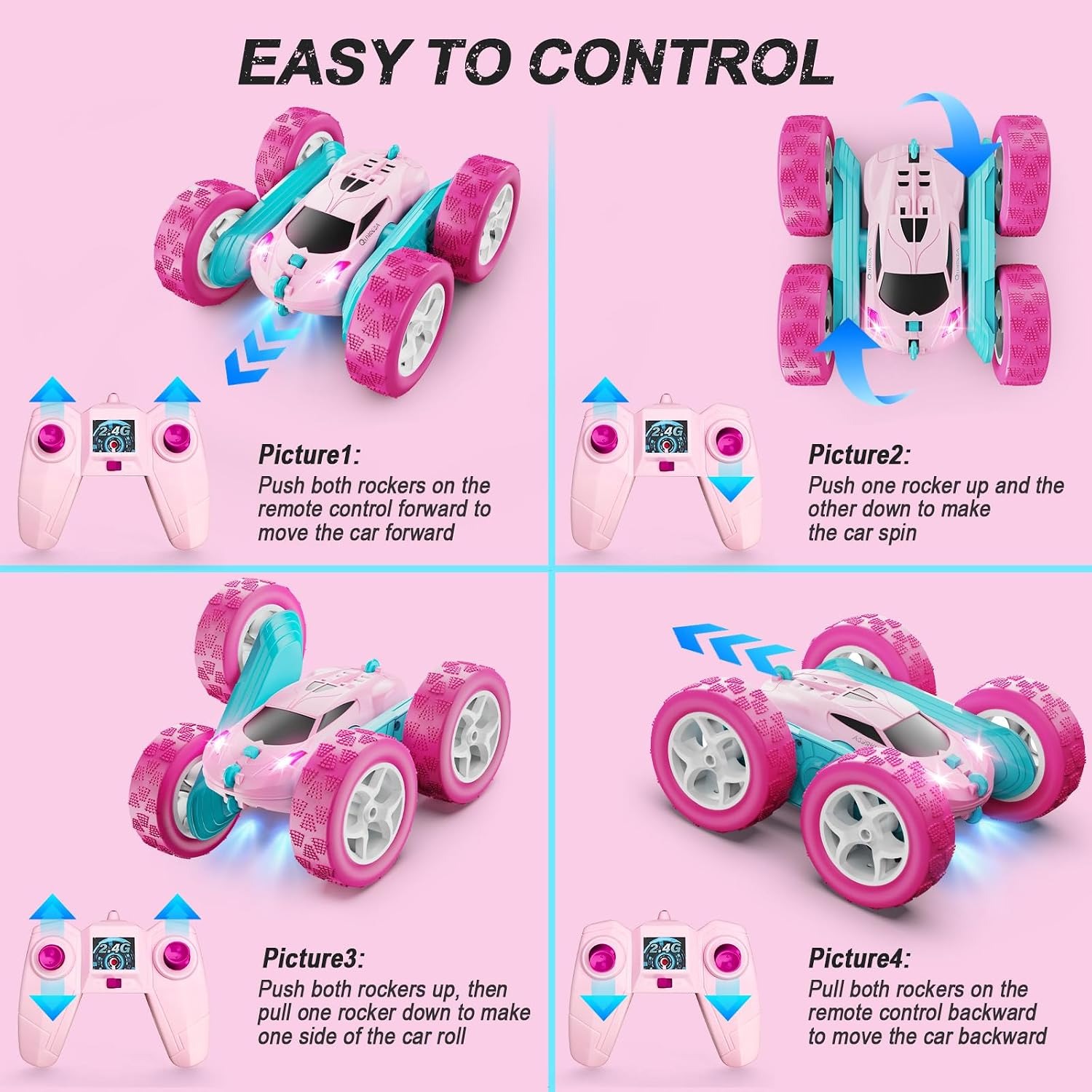
The controller has two buttons. That is the whole interface. A lot of parents see that and assume the car must be limited, but it works the other way round. Because there is nothing to learn, a child is driving within seconds of opening the box.
The depth comes from combinations. Forwards and backwards are the obvious ones. Hold things differently and you get a clockwise spin on the spot, or an anticlockwise one. Keep the car moving and you can trigger a full 360 degree double sided rotation, which is the move that gets the biggest reaction. You can also set up one sided tumbling flips while driving forwards or in reverse. The manual lists nine distinct moves in total.
What this means in practice is a long tail of interest. The first session is about driving fast. The fourth session is about landing a spin exactly where you wanted it. That progression is what separates a toy that lasts from one that does not.
The battery situation
This is the part worth paying attention to, because battery life is where most kids' RC cars disappoint.
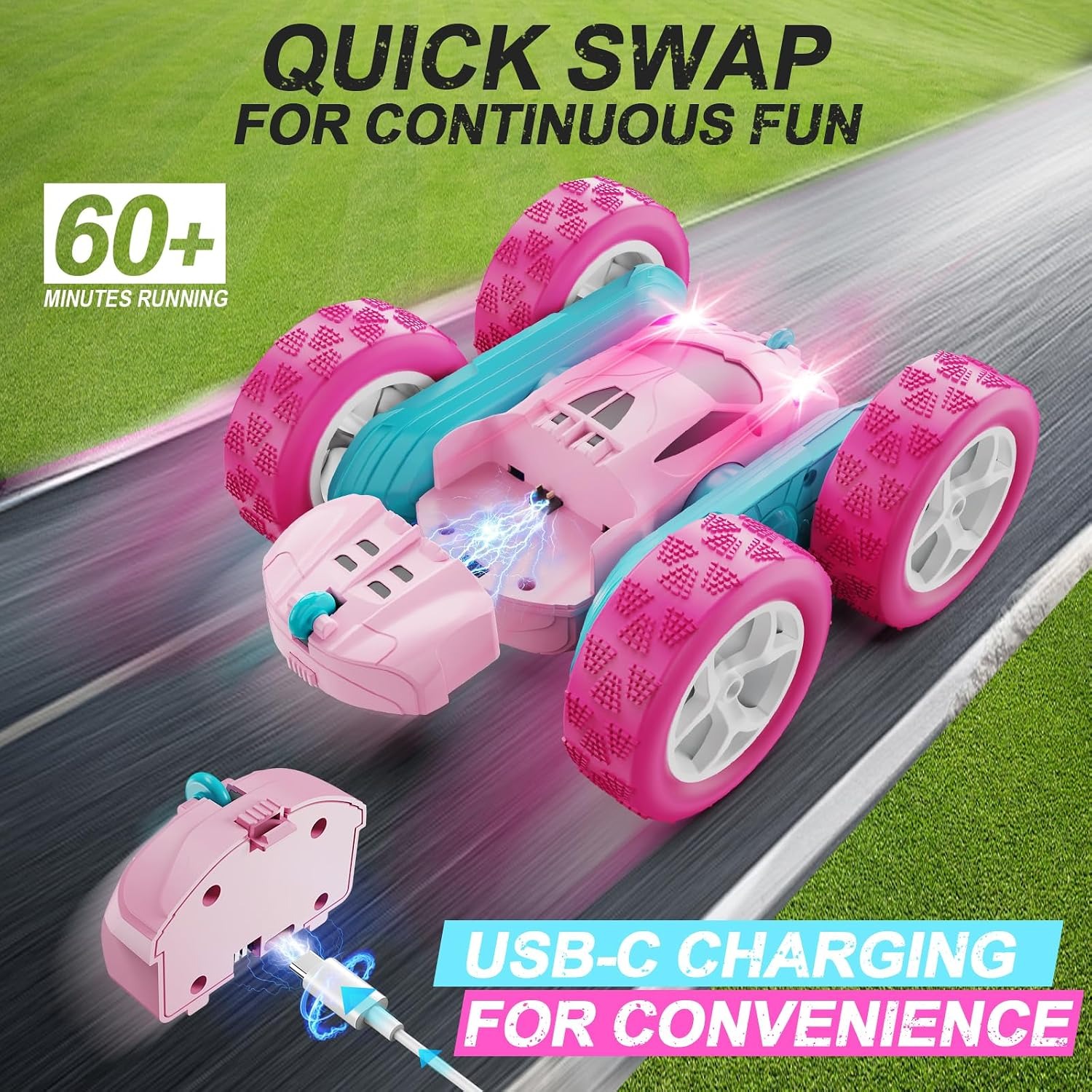
Each rechargeable lithium-ion module gives around 25 minutes of play. On its own, 25 minutes is a bit short for a Saturday afternoon. QUNREDA's answer is to supply two modules, one already in the car and one spare in the box. That takes you to roughly 50 minutes of driving, and more importantly it removes the dead time. As soon as the first module fades, pull it out, drop the second one in, and plug the first into the supplied cable.
The modules are housed in their own ABS shells and sit flush with the car body. They pull out by hand, no screwdriver needed for a routine swap. From a safety point of view this is also better than a sealed internal battery, because the charging happens away from the car and it is easy for an adult to keep the cable and the charging spot in one known place.
A note on supervision. Any lithium-ion charging deserves an adult eye on it. Use only the cable supplied, unplug it once charging is finished, and do not leave a module charging overnight or on a bed or sofa.
Where it can actually be driven
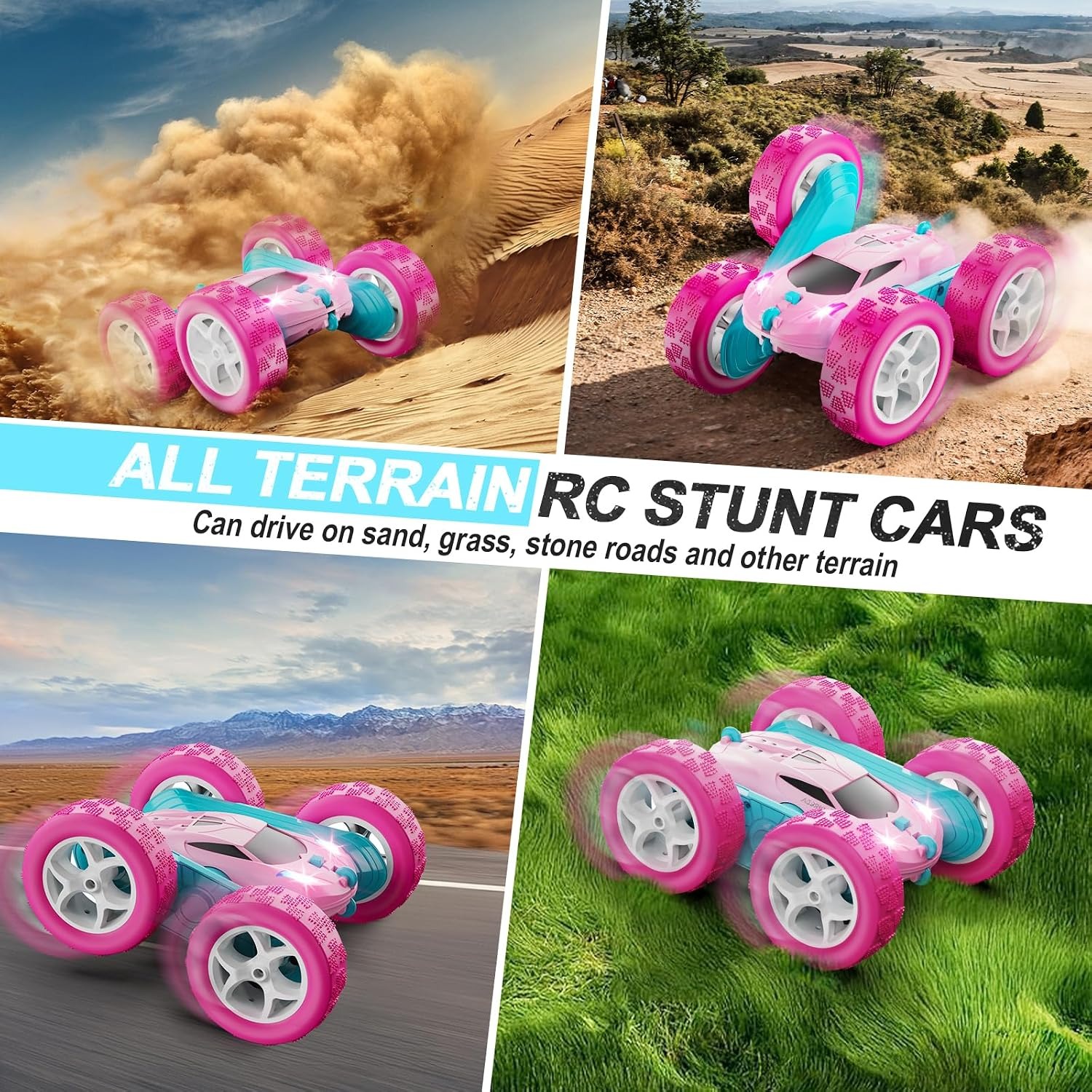
The tyres are made from a softer grade of ABS than the body. That gives three things at once: grip, a bit of shock absorption on landings, and resistance to skidding on smooth surfaces.
Indoors, it handles carpet, laminate, tiles and wood. Carpet slows it down a little and eats battery slightly faster, but it works. The main indoor constraint is floor space rather than surface. Spins and flips need room, so a cleared hallway or a living room with the coffee table pushed back works better than a bedroom.
Outdoors, it copes with grass, sand, packed dirt and damp ground. Beach play is genuinely good with this kind of car because a sand landing is soft and the double sided design means burying it upside down is no drama. Two things to avoid: standing water and loose gravel. No waterproof rating is given for this model, so keep it out of puddles and rain. Gravel tends to work its way into wheel wells on any small RC car.
Choosing the right car for your child
A few honest questions help here.
How old are they? This one is rated 6 and up. Below that, the stunt combinations tend to be frustrating rather than fun, and the small parts in the box are not ideal. Six to twelve is where it lands best.
Where will it be driven? If the answer is mostly indoors on hard floors, a stunt car like this is a strong pick because it does not need a track or a ramp to be interesting. If the answer is rough outdoor terrain at speed, you are looking at a different and more expensive category of hobby vehicle.
Is anyone else getting one? If a sibling or a friend has a similar car, the anti-interference 2.4GHz link turns a solo toy into a two-player game. Racing and chasing extend the life of a toy more than any single feature.
How patient is the adult? Cars that need picking up every ninety seconds end up being an adult's job. This one does not, which is a small thing that matters a lot on a wet Sunday.
Looking after it
Care is straightforward. Take the battery module out before cleaning anything. Wipe the shell and tyres with a dry or just-damp cloth. Never run it under a tap.
After beach or dirt play, brush around the wheels and axles so grit does not build up and bind the drive. A soft toothbrush works well for this. Let everything dry fully before you put a battery module back in.
For storage, keep the car, the spare module and the cable together somewhere cool and dry. Leaving lithium cells completely flat for months is not good for them, so if the car is going away for a season, give the modules a partial charge first.
The short version
This is a pink double sided stunt car for children aged 6 and up, running at up to 10 km/h on a 2.4GHz link with 50 metres of range. It drives either way up, does nine moves from a two-button controller, and ships with two rechargeable battery modules giving roughly 25 minutes each.
It is not a hobby-grade racer and it is not pretending to be. What it is, is a toy that keeps working when a child crashes it, which is the single most useful quality a first RC car can have. Add the spare battery and the fact that several can run together without interference, and you have something that holds attention well past the first week.
If you are buying a present and the child is somewhere between six and twelve, this is an easy recommendation. If you are unsure about the age fit or the surfaces they will be driving on, message us and we will give you a straight answer.