
The complete guide
Choosing a Rainbow Xylophone, A Practical Buyer's Guide
The problem with most first instruments
Buy a toy keyboard or a plastic xylophone and you usually hit the same wall within a week. The notes are not quite in tune, so nothing a child plays sounds like the song they are trying to play. Or there are only five or six bars, so the tune runs out of notes halfway through. Either way, the child works out quickly that the thing in front of them does not do what they hoped, and it ends up at the bottom of a box.
A tuned wooden xylophone solves that. When the bars are actually in tune and there are enough of them, a child can play Twinkle Twinkle and have it sound like Twinkle Twinkle. That one moment of recognition does more for a child's interest in music than any amount of encouragement from a parent.
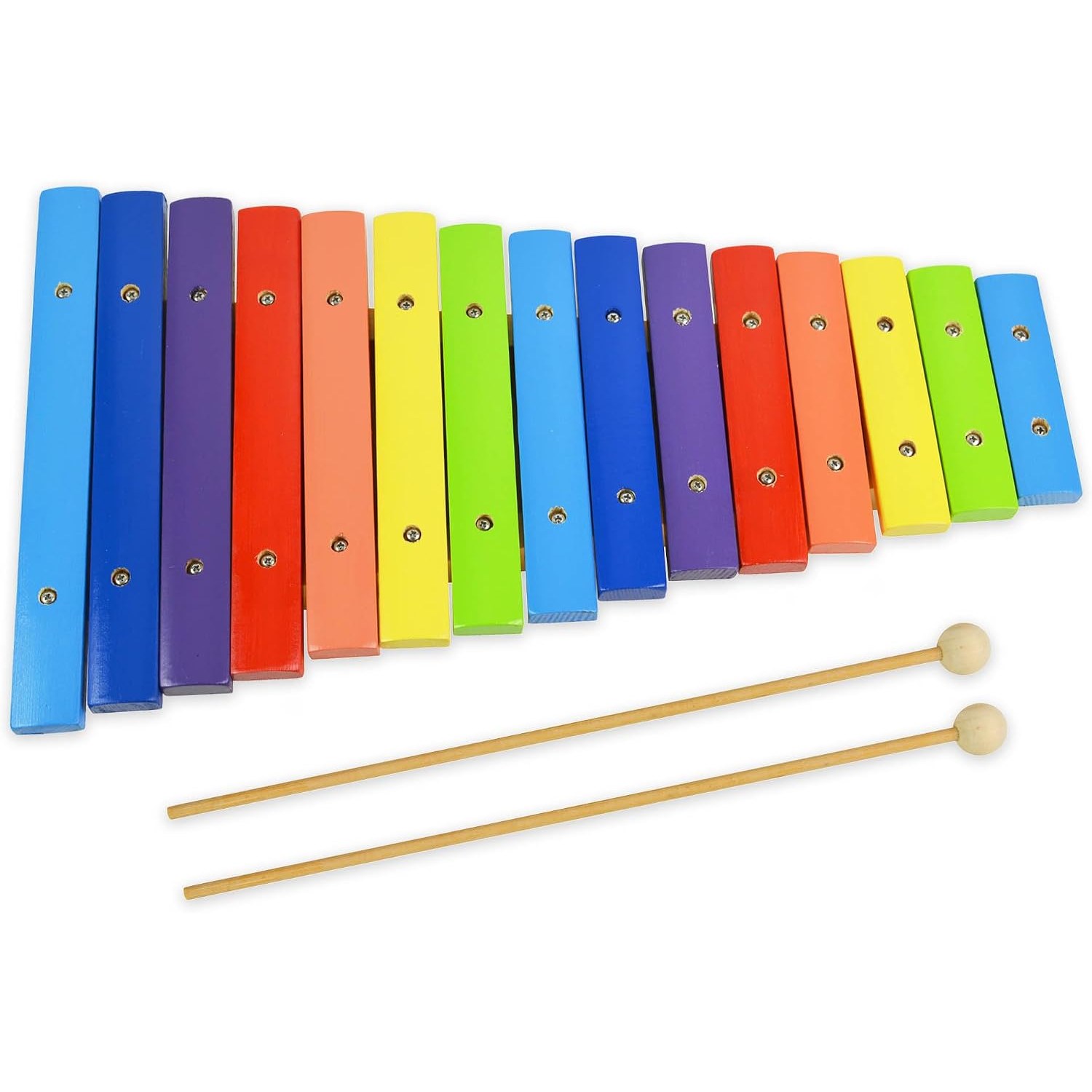
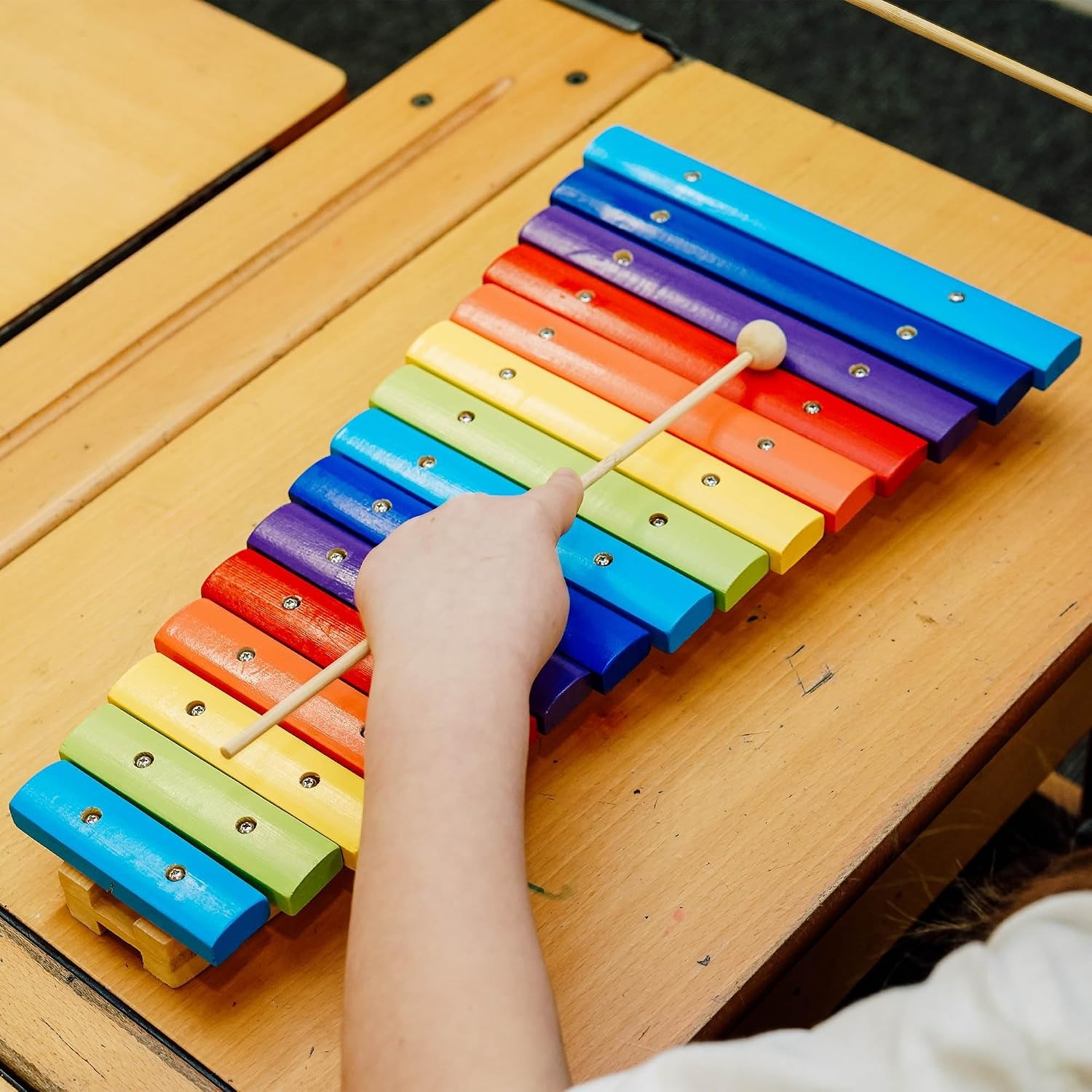
This model has fifteen bars tuned to the C major scale, which is the scale almost every beginner songbook and nursery rhyme sheet is written in. No sharps, no flats, nothing to get in the way.
How a tuned xylophone actually works
Each bar is a piece of wood cut and shaped to vibrate at a specific pitch. Longer bars vibrate more slowly and produce lower notes. Shorter bars vibrate faster and sound higher. That is why the bars step down in size from left to right.
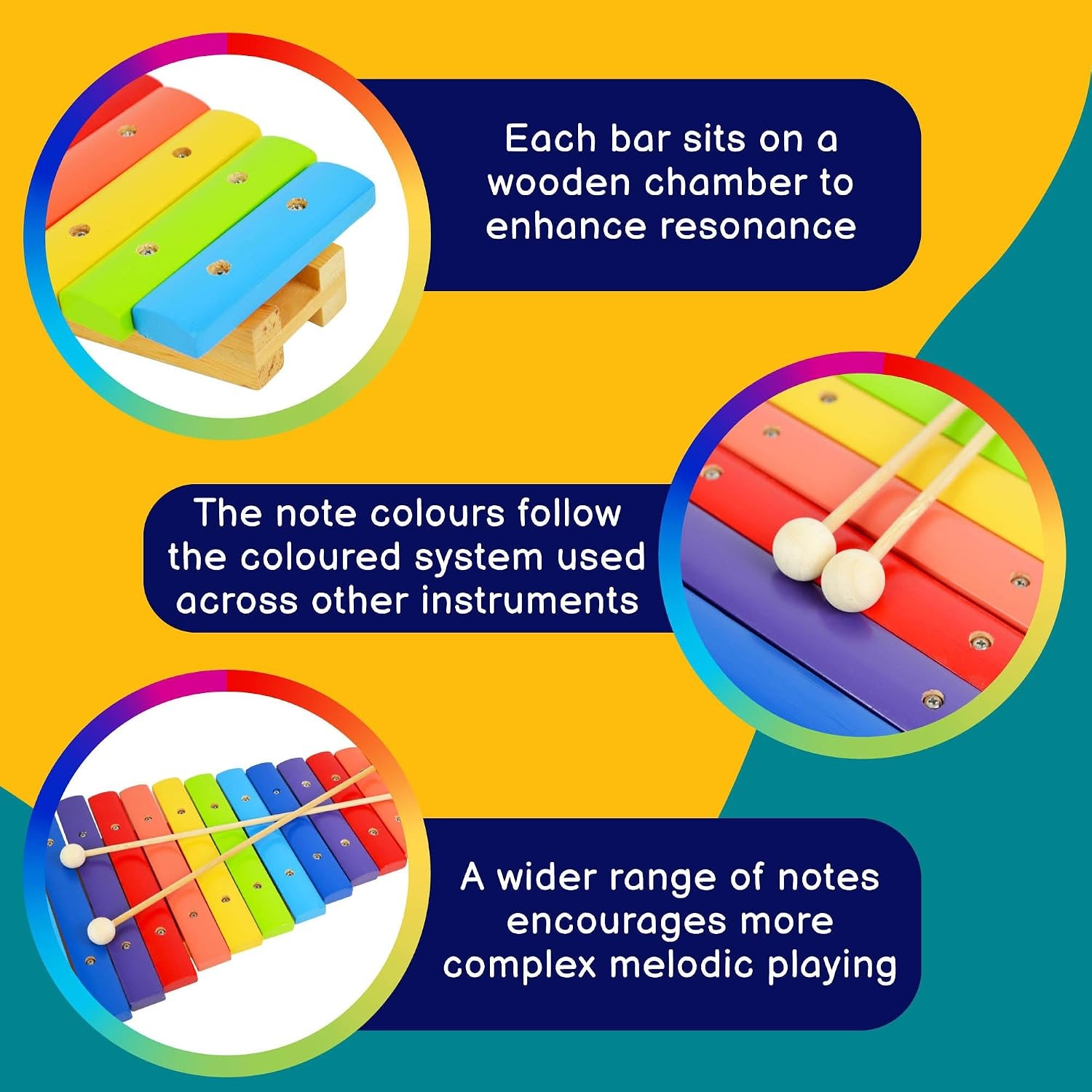
The base matters more than people realise. The bars sit above it rather than flat on it, so they can vibrate freely, and the body underneath helps the sound carry. This is why the instrument sounds noticeably better on a table than on a duvet. A hard surface lets the base do its job. A soft one absorbs the vibration and you get a dull thud instead of a clear note.
The beaters make a difference too. Wooden beaters on wooden bars produce a bright, crisp attack with good definition between notes. That clarity is helpful in a group, where several children playing at once can otherwise turn into mush.
Why the colours are not just decoration
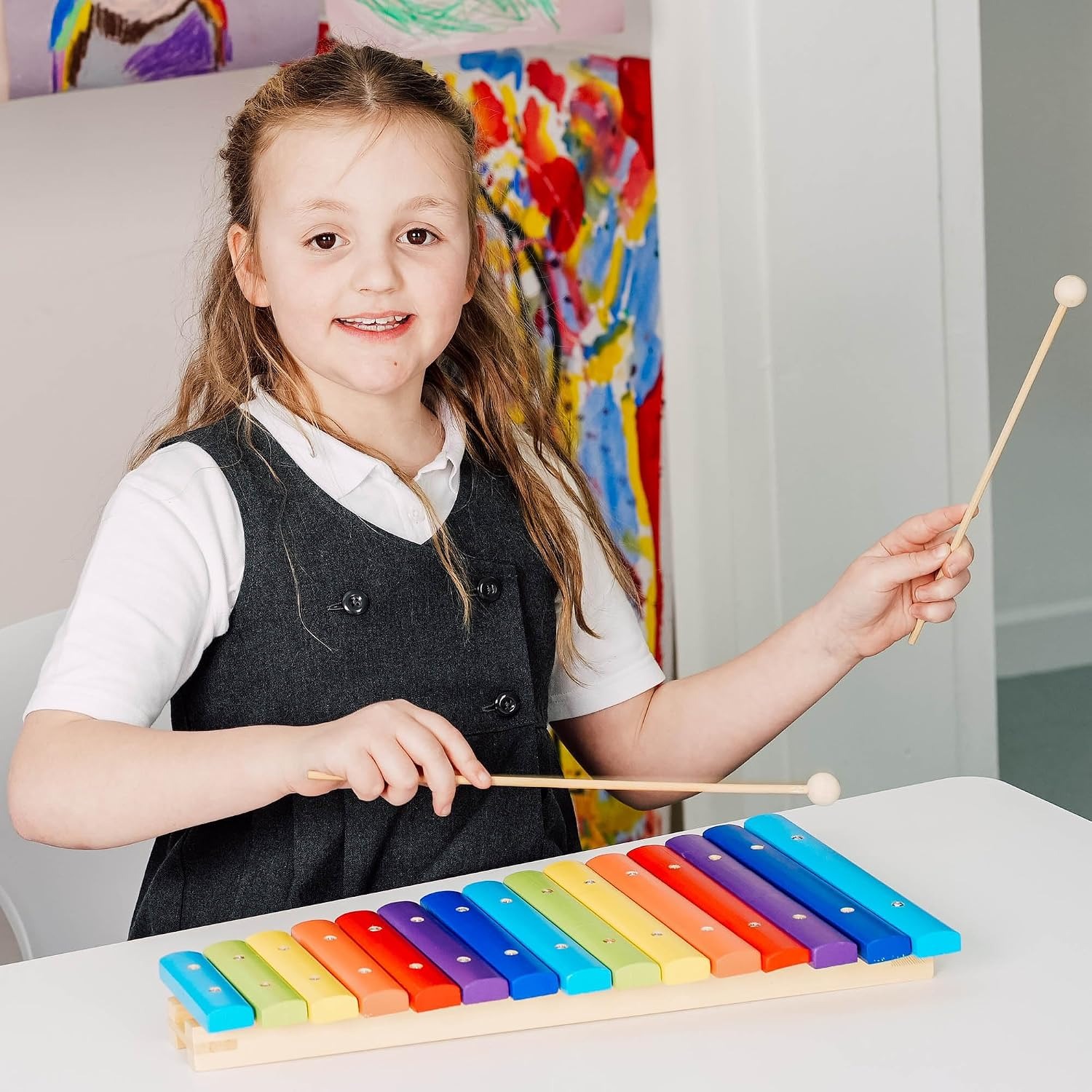
The rainbow look sells the instrument, no question. But the colours do real work. They follow the coloured note system used widely in early years music teaching, where each note of the scale has a consistent colour. A child who cannot read a stave can still read a colour chart, press the matching bars in order, and play a correct tune.
That short cut matters because the usual route into music asks a lot of a small child at once. Read the symbol, work out the pitch, find it on the instrument, then hit it in time. Colour coding removes two of those steps. What is left is finding the bar and hitting it in time, which is achievable for a four or five year old.
Later, when a child moves to standard notation, they already understand that notes have an order, that going right means going higher, and that a tune is a pattern. The groundwork is done. A good colour coded xylophone is a teaching aid as much as a toy.
Who this suits
Parents of preschool and primary age children are the obvious fit. The manufacturer states it is not suitable for children under 36 months, so this is not a baby toy, and that is worth paying attention to.
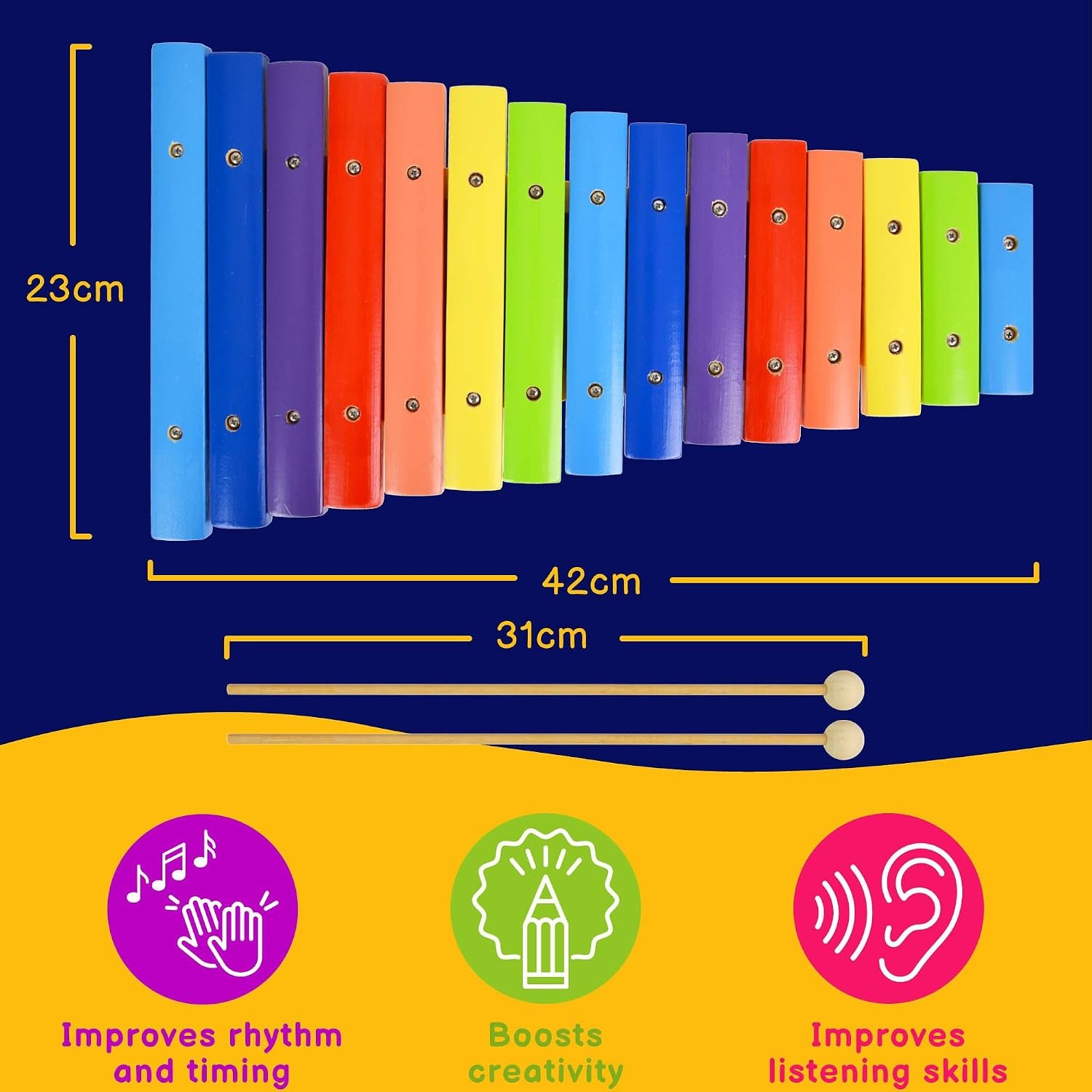
Teachers are the other big group. Fifteen notes gives you enough range to teach melody, pitch and timbre properly rather than just demonstrating high and low. For a classroom set, the compact 23.2 x 21.5 x 4.3 cm footprint means several fit in one storage crate, and the included bag keeps each set's beaters with its own instrument instead of loose in a drawer.
It also suits anyone running music groups, after school clubs or sensory sessions. Tuned percussion gives an immediate, pleasant result from a very small physical effort, which is useful when you are working with children who find other instruments frustrating.
How to choose between models
A few things separate one wooden xylophone from another, and they are worth knowing before you compare.
Note count is the first. Eight note models cover a single octave and will play some nursery rhymes but not all. Fifteen notes gives you roughly two octaves of a diatonic scale, which is enough for most beginner material and leaves room to grow. If a child is already playing and getting frustrated by an eight note model, this is the natural step up.
Material is the second. Wood gives a warmer, rounder tone than metal and tends to be gentler on the ears in a small room. Metal bars, as found on a true glockenspiel, ring longer and brighter. Both are valid, but a wooden xylophone is usually the easier one to live with at home.
Tuning is the third, and it is the one that separates a real instrument from a toy. Precisely tuned bars mean the thing can be played alongside a piano, a recorder or a singing adult without clashing. Untuned bars sound approximately right on their own and wrong the moment anything else joins in.
Finally, check what comes in the box. Beaters are not always included, and a storage bag almost never is. Both are here, which keeps the total cost and the hassle down.
Getting the best sound from it
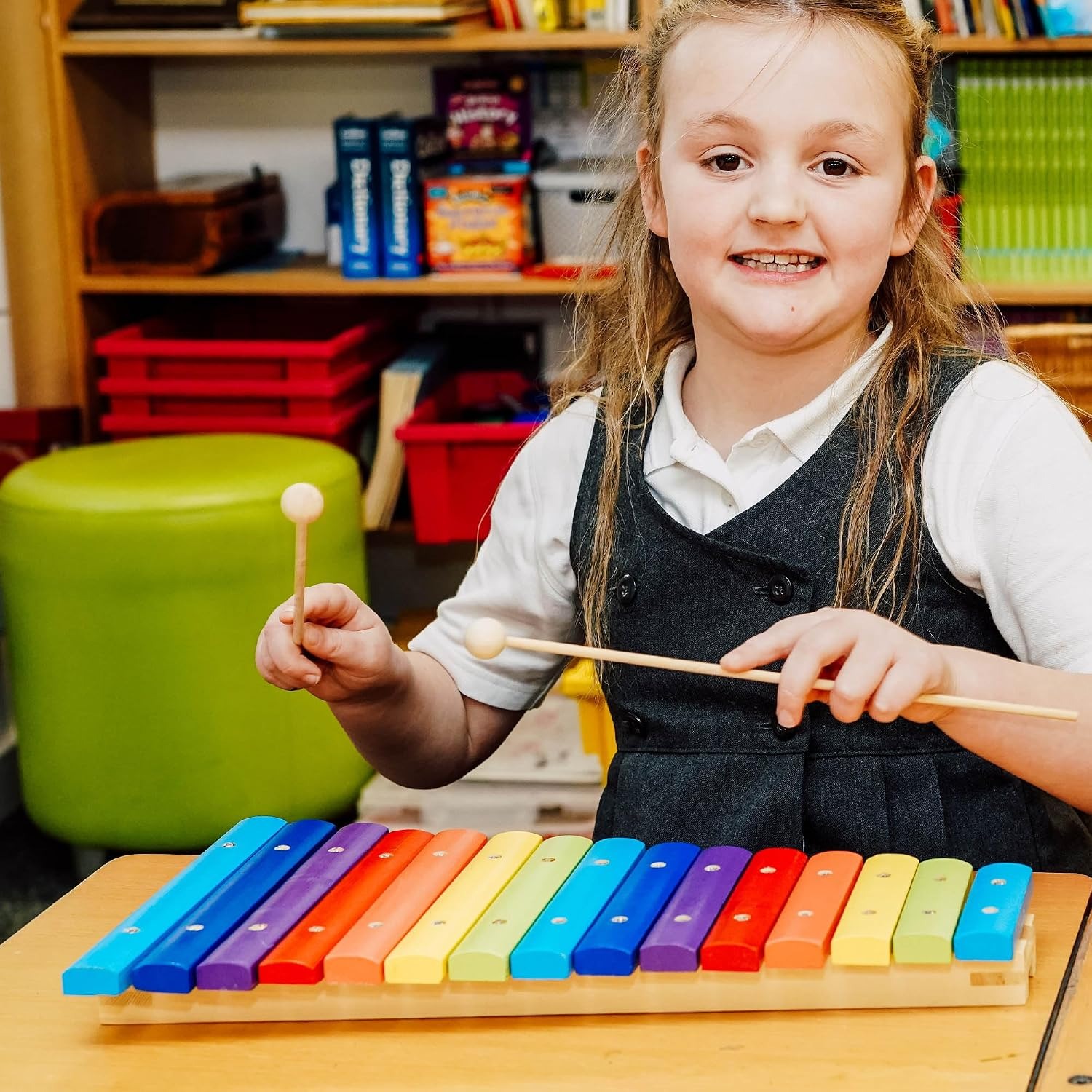
Put it on something hard. A kitchen table, a desk, a wooden floor. The resonance improves immediately.
Show a child how to let the beater bounce off the bar rather than pressing into it. A bounced strike lets the bar keep ringing. A pressed strike stops the vibration dead and the note sounds choked. This is the single easiest technique improvement for a beginner and it takes about thirty seconds to teach.
Strike near the middle of the bar, not at the ends. The centre is where the bar moves most freely and where the tone is fullest.
If a bar sounds buzzy or flat compared to its neighbours, check that it is sitting properly and that the screw fixing has not worked loose. Reseating it usually restores the tone.
Looking after it
Wood needs very little, but it does need the right conditions. Wipe the bars and base with a soft cloth, dry or barely damp. Do not soak it, and do not put any part of it near a dishwasher.
Keep it away from radiators and direct sunlight, which dry wood out, and away from bathrooms and damp utility rooms, which do the opposite. A normal shelf or cupboard in a living space is fine.
Store the beaters with the instrument in the bag. Lost beaters are the most common reason a xylophone stops being played, and they are the easiest problem to prevent.
Give the fixings a quick check every few months, especially if the instrument is in regular classroom use. Tightening a loose screw takes a moment and keeps the bars sounding as they should.
The short version
This is a 15 note wooden xylophone tuned to C major, with colour coded bars, a wooden base, two wooden beaters and a storage bag. It measures 23.2 x 21.5 x 4.3 cm and weighs 0.75 kg. It is not suitable for children under 36 months.
If you want a first musical instrument that a child can actually play tunes on, rather than one they will rattle twice and abandon, the combination of real tuning, a useful note range and colour coding is what you are paying for. Put it on a hard surface, teach the bounce, keep the beaters in the bag, and it will stay in use far longer than the usual starter toy.