
The complete guide
Choosing a Solar System Floor Puzzle, A Parent's Guide
The problem with most puzzles kids are given
There is a gap in children's puzzles that catches a lot of parents out. For ages one to three there are chunky wooden boards with six or nine pieces. For ages eight and up there are 500-piece landscapes. In between, families end up buying a 24-piece puzzle that gets completed in four minutes and never touched again, or a 200-piece set that produces tears by piece thirty.
What a child between three and eight needs is something that takes real effort but ends in success. That feeling, the one where they look at a finished picture and know they did it, is what makes them want to do it again. A puzzle that is too easy never gives it. A puzzle that is too hard takes it away.
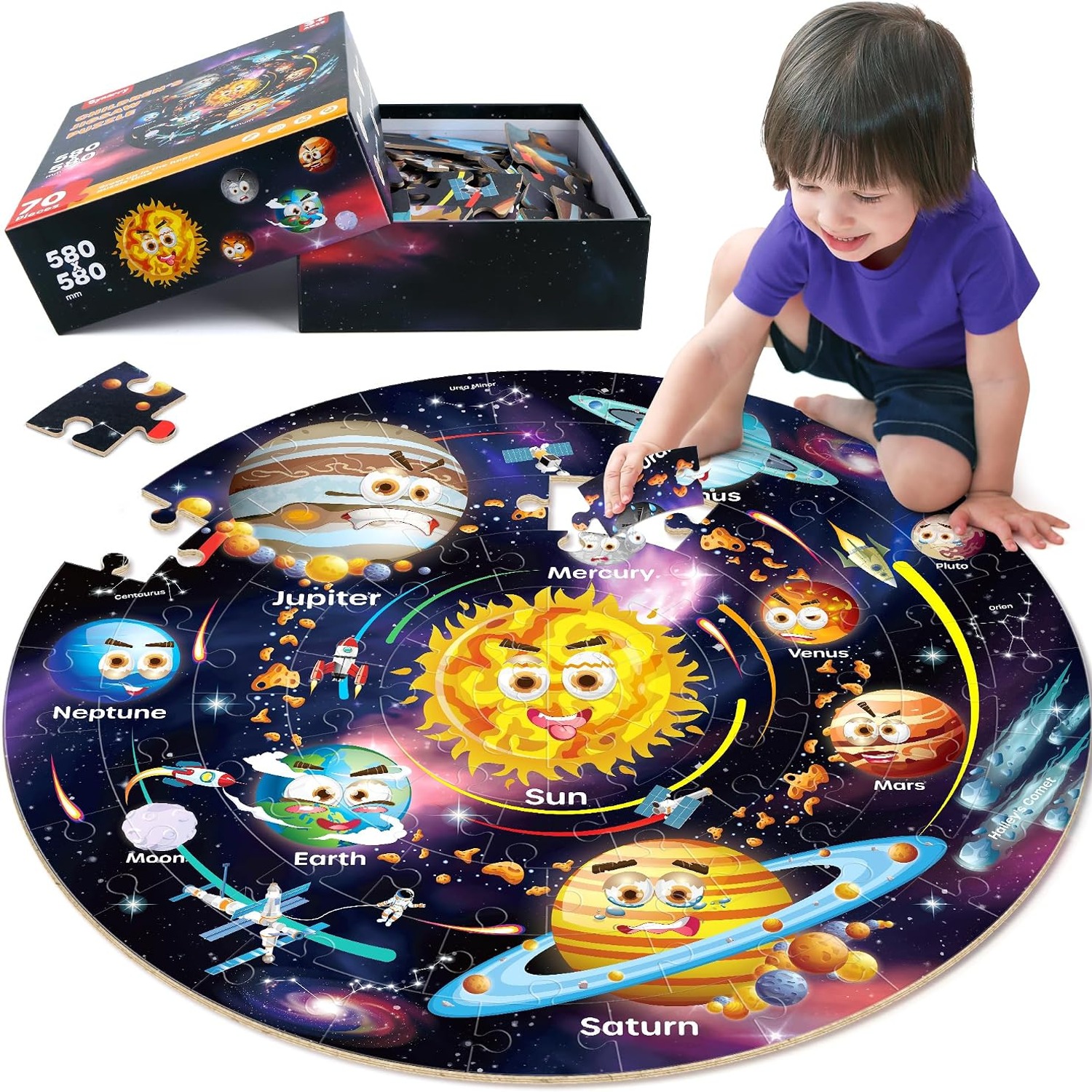
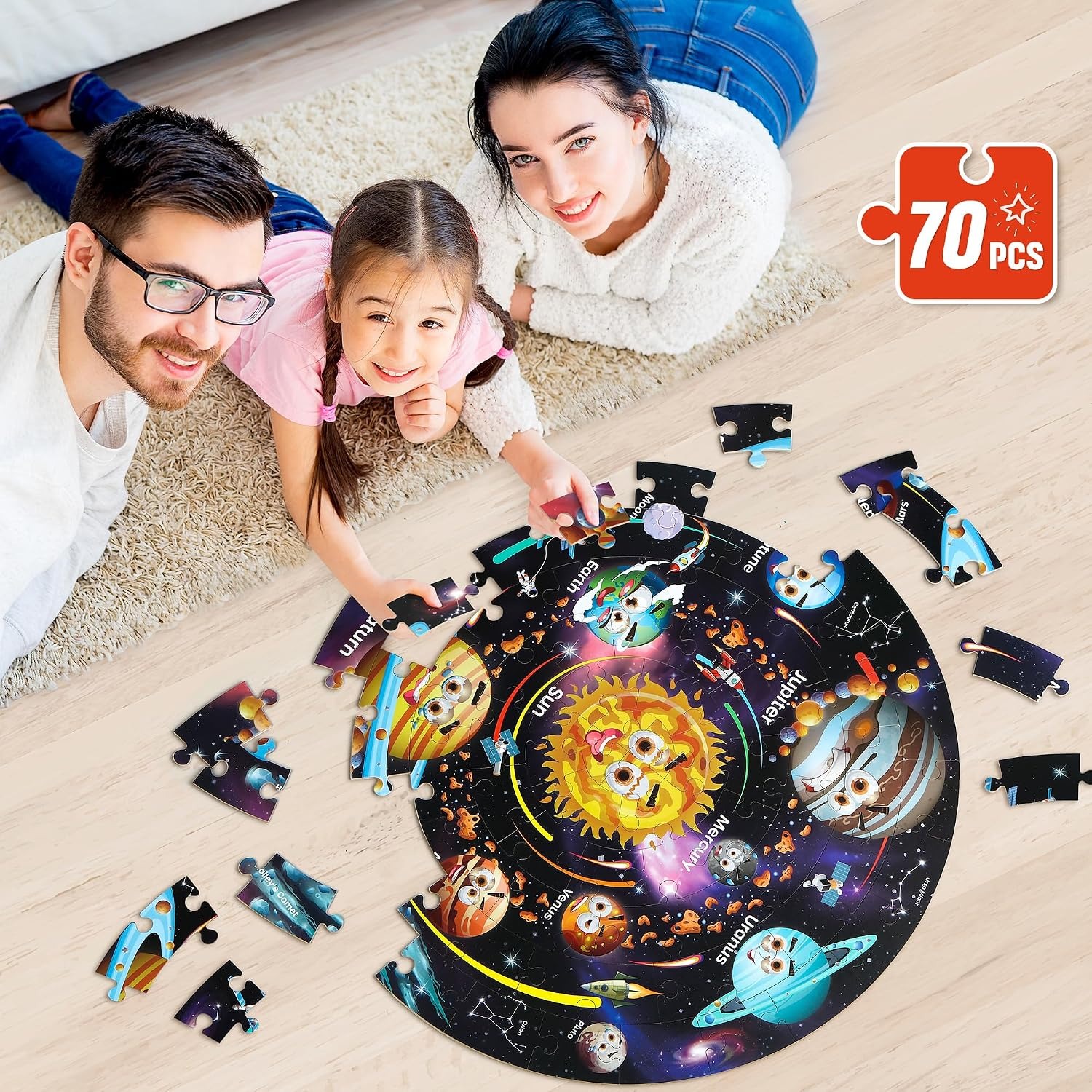
Seventy pieces sits right in that useful middle. It is a genuine project for a four or five year old, usually with an adult nearby for the first attempt, and it stays interesting for a seven year old who now wants to beat their own time. That range is part of why a solar system floor puzzle like this one tends to get rebuilt rather than shelved.
Why space works so well as a theme
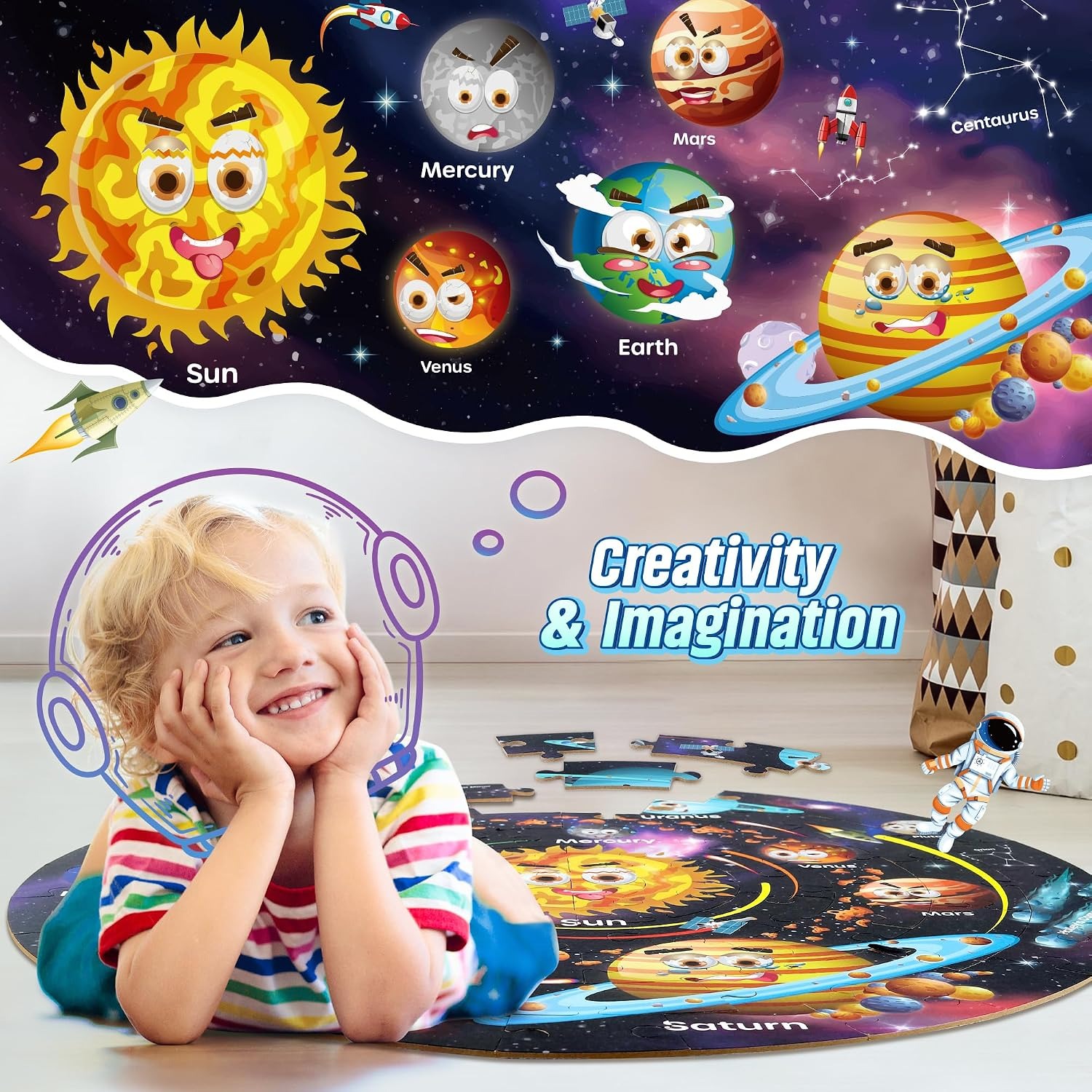
Children do not need to be told space is interesting. Planets are enormous, they are real, and they are far away, which is a combination that hooks most kids somewhere around their fourth birthday. Ask a five year old what they want to be and "astronaut" still polls well.
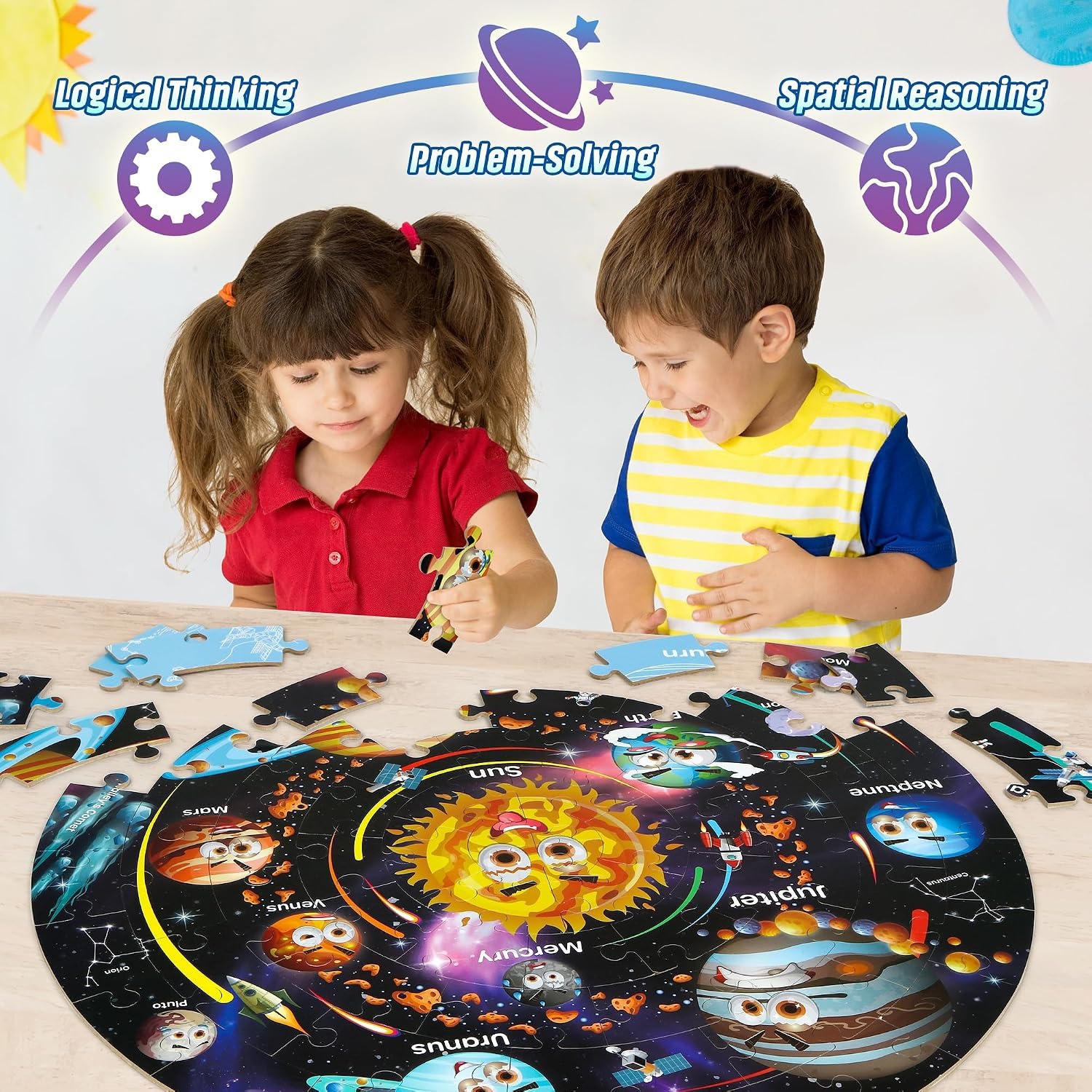
The practical benefit is attention. A child who cares about the subject will sit with a puzzle longer than one who does not, and longer sessions are where the actual skill building happens. The stated educational aims here are concentration, hand-eye coordination, matching, patience and problem solving. None of those improve in a five-minute burst. They improve when a child stays with a tricky section rather than giving up.
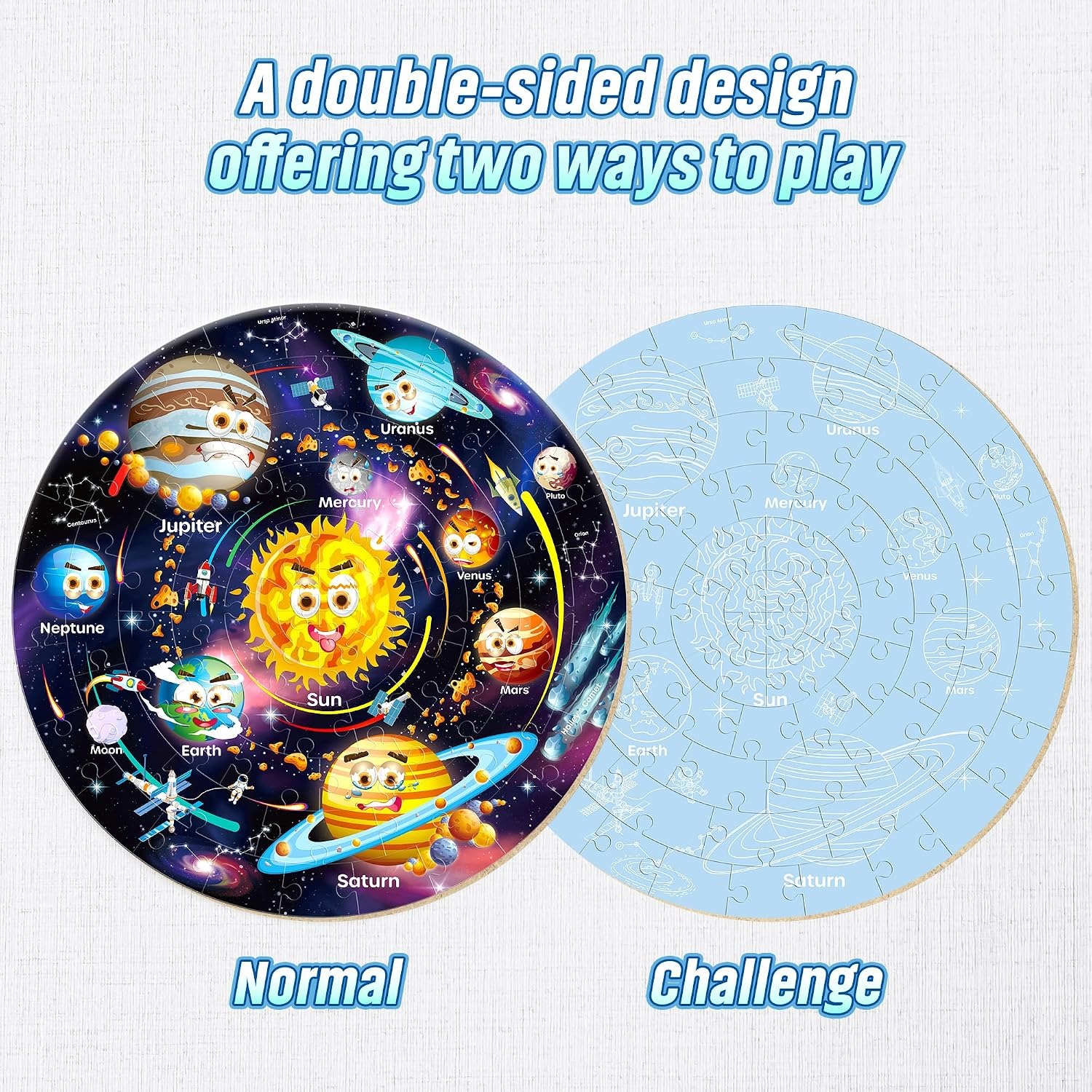
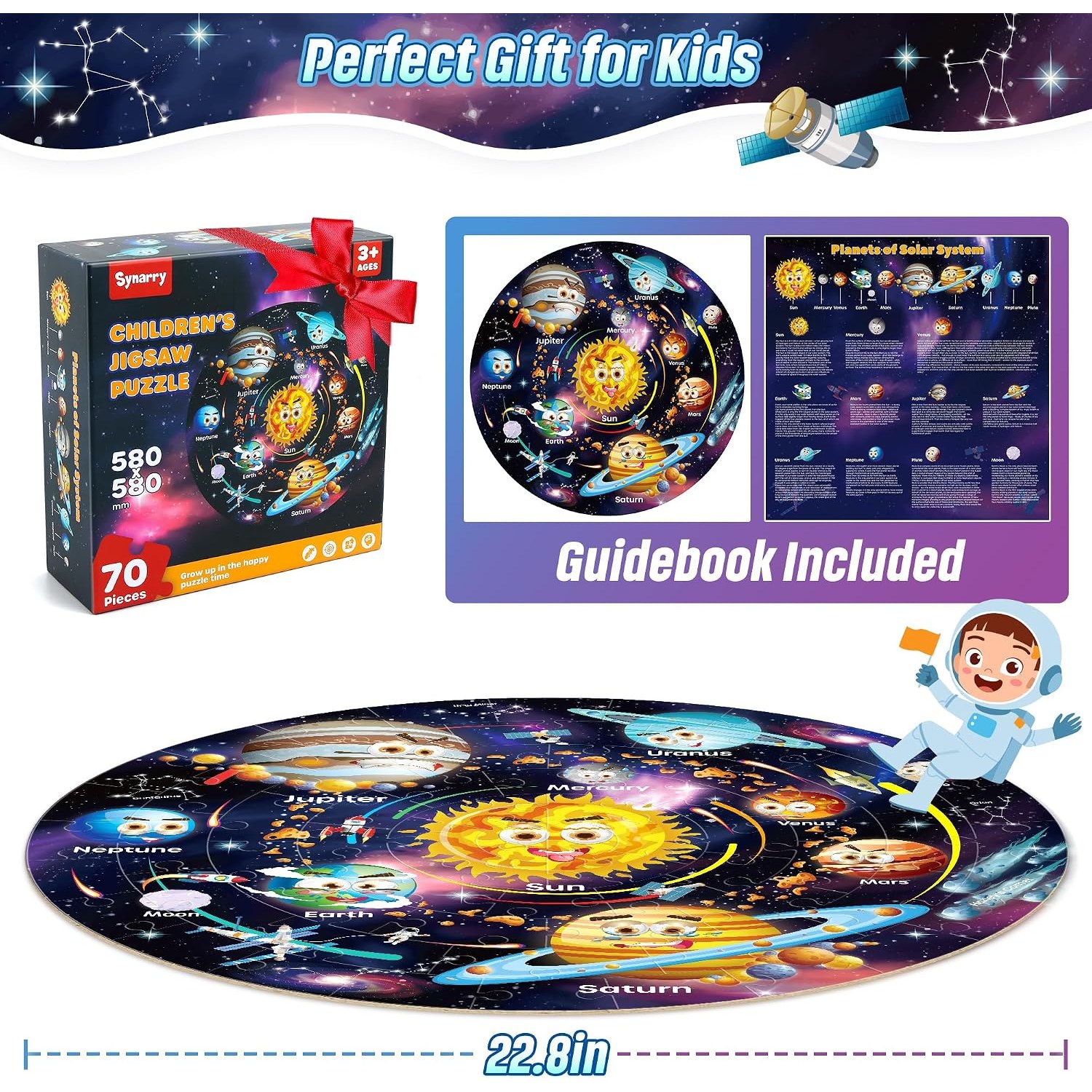
There is a learning side too. This puzzle shows the sun and the planets in bright cartoon artwork rather than as a technical chart, which suits the age group. Handling the picture over and over builds a mental map. Say the planet names out loud as you place pieces and you have turned a rainy afternoon into a science lesson nobody noticed was happening. Parents often hunt for the best planet puzzle for preschoolers for exactly this reason, something that teaches without announcing it.
What the round shape changes
Most jigsaws start the same way. Find the flat-edged pieces, build the frame, fill the middle. It is a reliable strategy and children learn it fast.
A round puzzle removes that crutch. With no straight border to assemble first, a child has to work from the picture instead, matching a colour to a colour or a half-planet to its other half. That is harder in a good way. It pushes them toward pattern recognition and spatial reasoning rather than a memorised routine.
It also means the first build is usually slower than the second. Expect some help needed on day one. By the third or fourth attempt most children have a strategy of their own, often starting with the sun or whichever planet they like best and working outward. Watching that strategy develop is quietly satisfying.
Who this suits, and who it does not
The manufacturer recommends 36 months to 8 years, and that range is honest rather than optimistic.
A three year old can take part, but they will be a helper rather than the builder. Hand them a group of eight or ten pieces that clearly belong together and let them finish that patch while you handle the rest. Four and five year olds are the sweet spot. Expect the first build to take a while with support, and expect them to want to do it again almost immediately.
Six and seven year olds will often manage it solo. The challenge shifts from "can I do this" to "how fast can I do this", which keeps it in rotation. At eight it becomes an easy win, still useful for quiet time but no longer a stretch.
Below three, skip it. Small pieces and children who still mouth things are a poor combination, and no puzzle is worth that worry.
Materials and what the record actually says
The material is listed as wood, and the maker states it is PVC-free, latex-free, phthalate-free, BPA-free and lead-free. The pieces are cut with finished edges so they are comfortable for small hands to grip and press together.
The item dimensions given are 21 x 21 x 0.1 cm, with an item weight of 1.8 lb, roughly 0.82 kg. It is listed as portable, single-player, indoor, and requires no assembly.
Country of origin and warranty are not specified by the maker, so we are not going to guess at them. If either matters to your purchase, ask us before ordering and we will find out.
Getting the most out of it
A few habits make a noticeable difference.
Build on a hard flat surface. Deep-pile carpet lets pieces tilt and makes connections feel wrong even when they are right. A wooden floor, a rug with a tight weave, or a kitchen table all work better.
Sort before you start. Tipping 70 pieces into a heap is overwhelming for a young child. Spreading them out face up and grouping them loosely by colour takes two minutes and removes most of the early frustration. For a child under five, this one habit is often the difference between a finished puzzle and an abandoned one.
Resist the urge to take over. When a child is stuck, the instinct is to place the piece for them. Try instead to narrow the field, something like "I think that one belongs near the yellow part". They still get the win, which is the whole point.
Count the pieces back into the box every time. A 70-piece puzzle with 69 pieces is a disappointment that is hard to fix.
Care and storage
This is simple, but worth doing properly if you want the set to survive a couple of years of use.
Keep food and drinks off the building surface. Juice on printed board is permanent. If something does mark a piece, wipe it with a barely damp cloth and dry it straight away rather than soaking it.
Store everything flat in the original box, out of direct sunlight and away from damp rooms. Strong sun fades printed colour over a season or two, and humidity is what makes board pieces swell and stop fitting cleanly.
Gifting it
It works well as a present because there is nothing to prepare. It arrives in its own printed box, needs no batteries, no app and no setup, and the age range is wide enough that you do not have to know a child's exact level to pick it. That makes it a safe choice for a birthday, Christmas, a new sibling distraction, or a long school holiday.
If you are giving it to a child who already owns several puzzles, the round shape and the space theme usually give it an edge over yet another rectangular farm scene.
The short version
This is a 70-piece round floor puzzle showing the solar system, made for children from about three to eight. The material is listed as wood, and the maker describes it as PVC-free, latex-free, phthalate-free, BPA-free and lead-free.
The piece count is the thing to focus on. Seventy is enough to be a real challenge for a preschooler and enough to stay interesting for a child who has outgrown chunky preschooler puzzles. Along the way it quietly works on concentration, matching, patience, hand-eye coordination and problem solving, and it teaches a child the planets without ever feeling like a lesson.
If your child points at the moon and asks questions, this is a good next step.