
The complete guide
The Buyer's Guide to Transforming Dinosaur Car Toys
The problem with most toy cars
Buy a child a toy car and you get about ten minutes. They push it, they crash it, they push it again, and then it ends up under the sofa with the other eleven cars. The toy does one thing, and once a child has seen that thing, there is nothing left to discover.
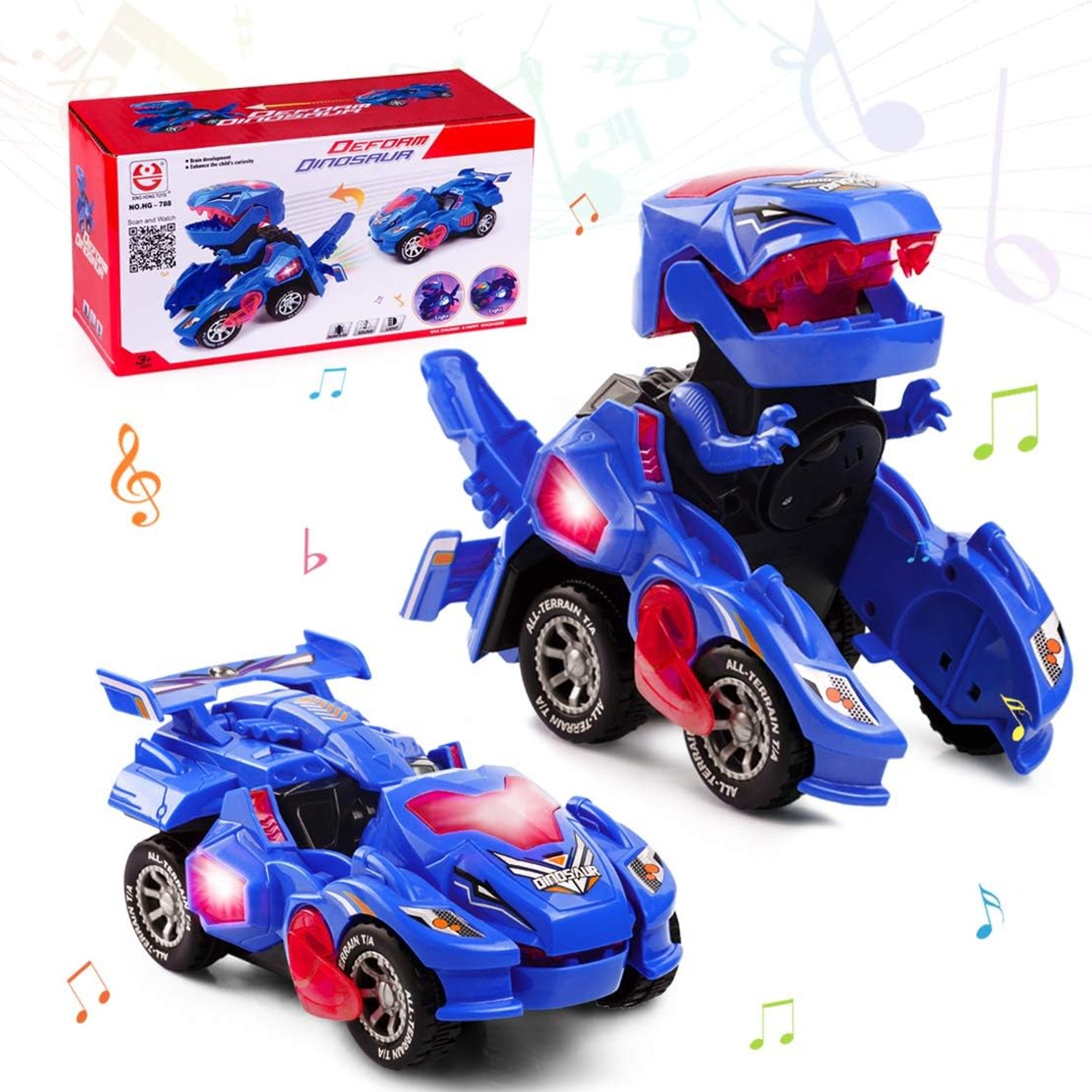
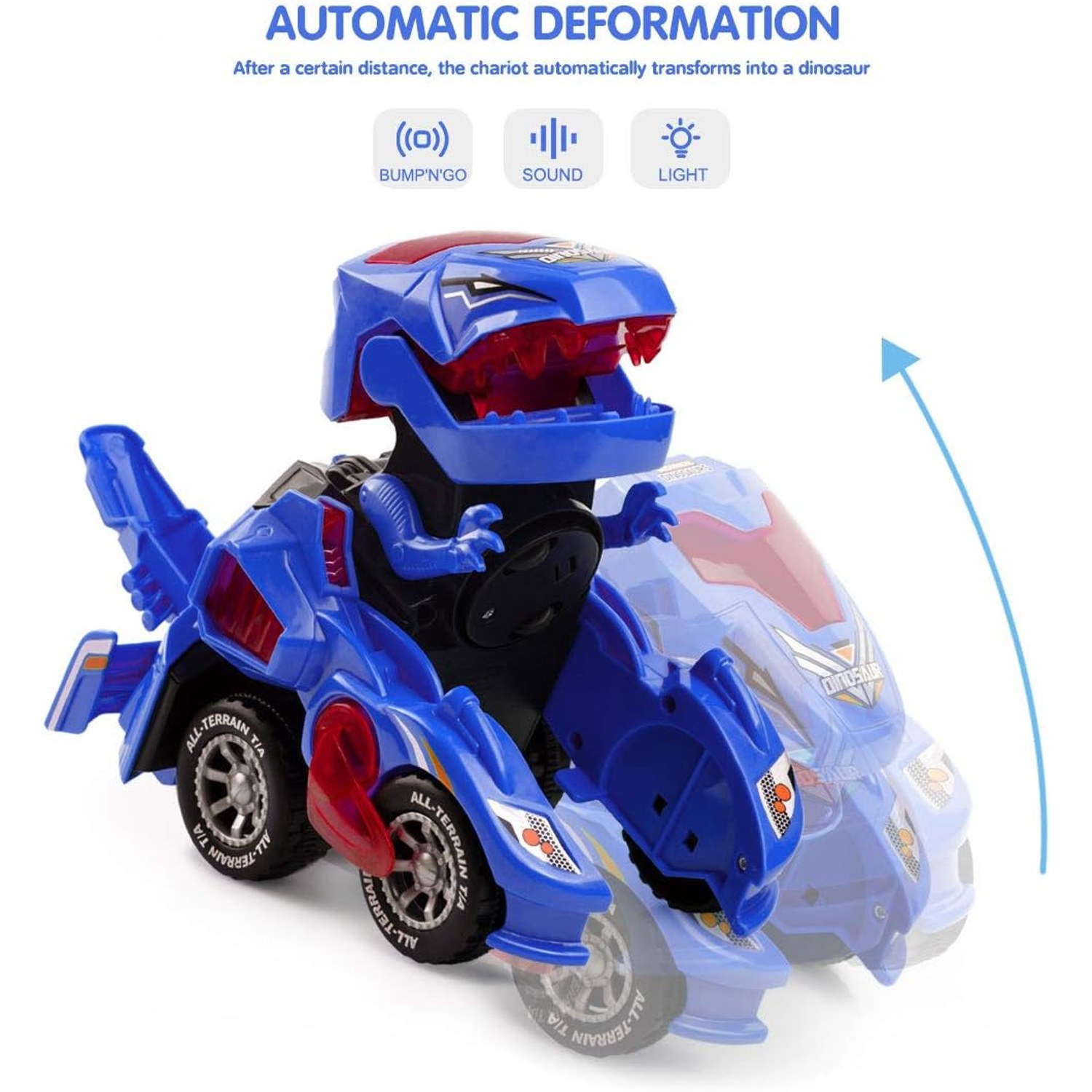
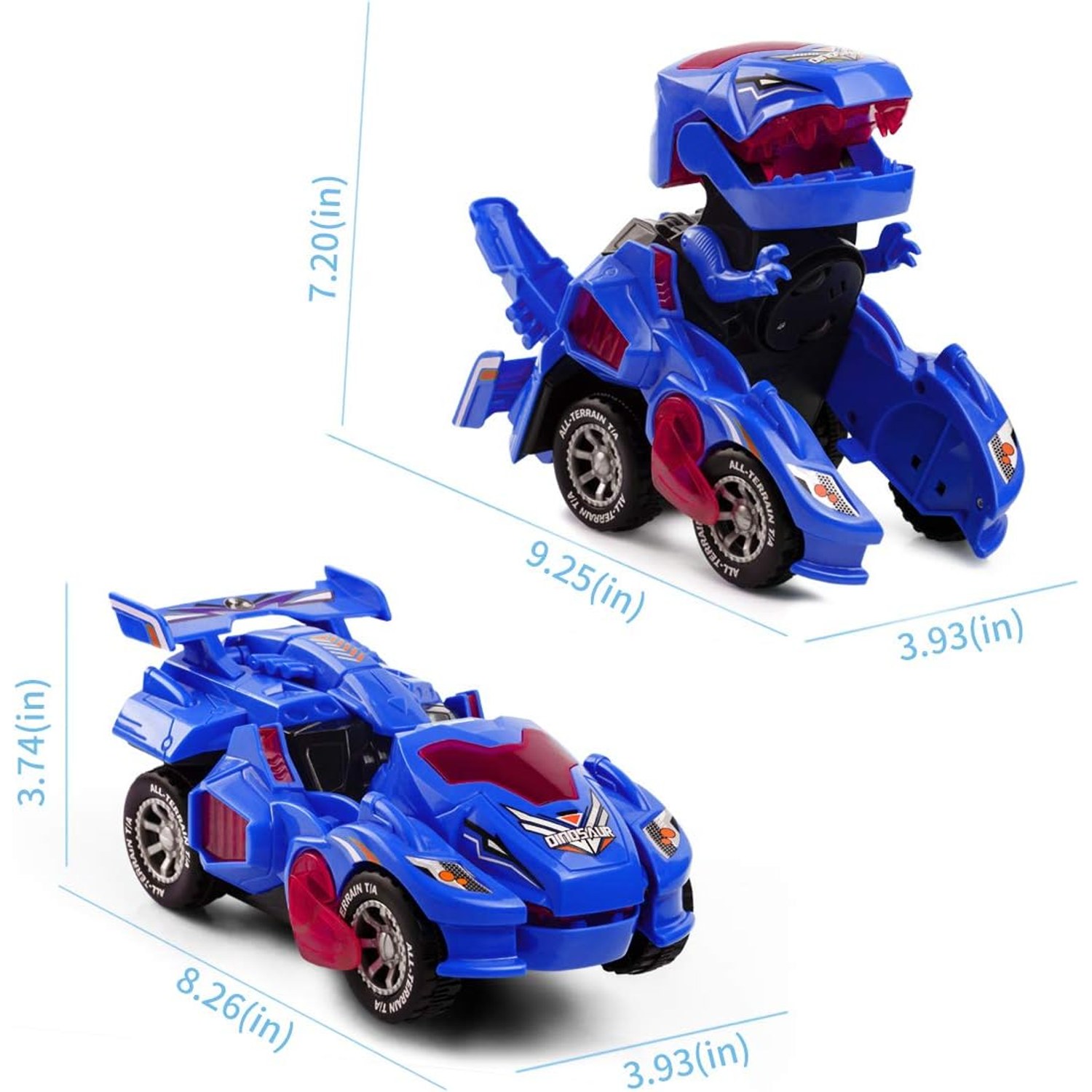
That is the gap a transforming dinosaur car fills. The first time a child puts it on the floor, it behaves like a normal vehicle. Then it slows, rears up, and turns into a dinosaur in front of them. The change is the whole point. It takes a familiar object and makes it do something unexpected, and that surprise is what buys you the extra playtime.
There is a practical side too. Plenty of toys in this age range need an adult. Something has to be built, clipped together, charged, paired with a phone or steered with a remote. This one does not. Fit batteries, switch it on, put it down. A three year old can run it without help, which matters on a wet afternoon when you are trying to get something else done.
How it works
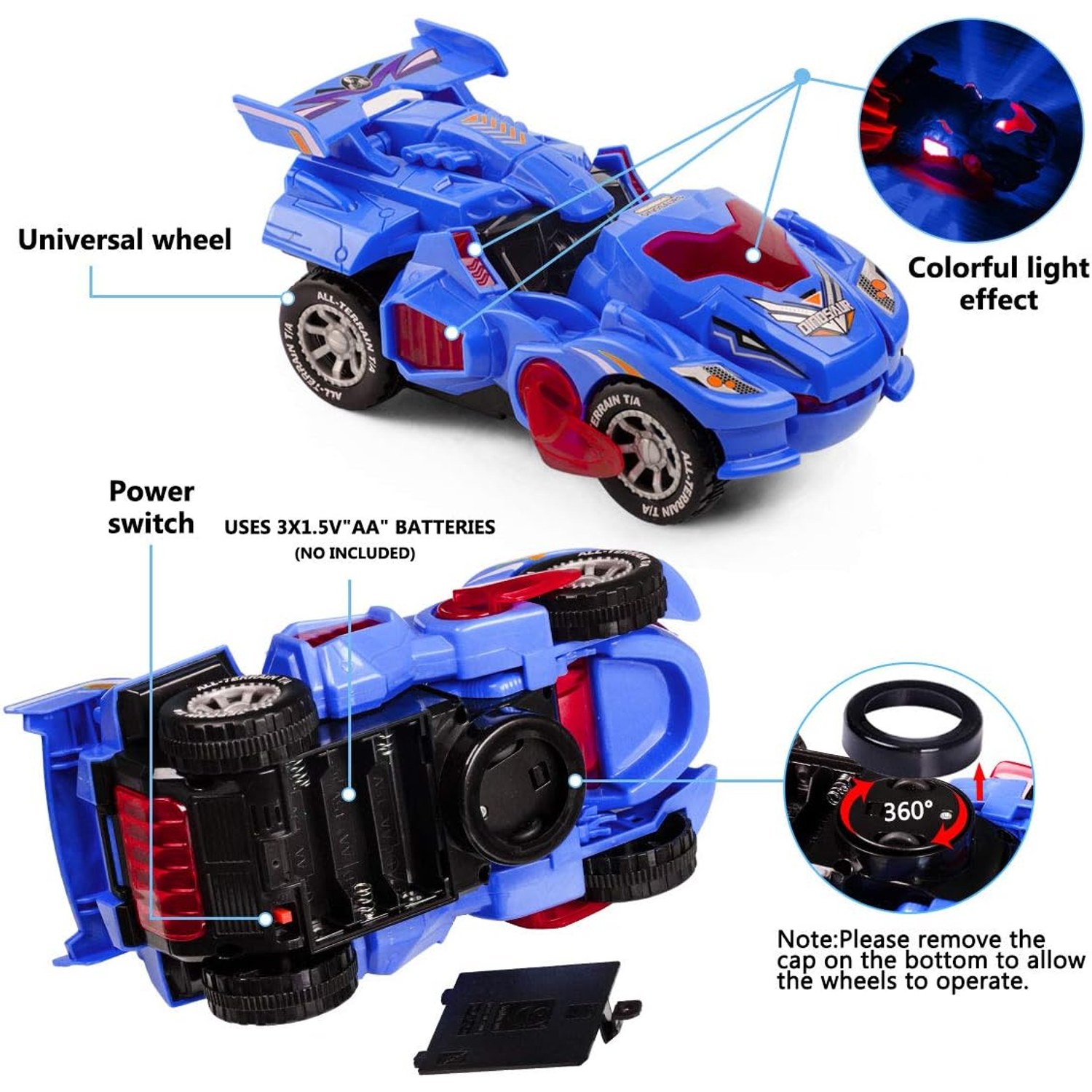
The mechanism inside is simple and that is a good thing. Three AA batteries drive a small motor. The motor turns the wheels, and on a timed cycle it also shifts the body, so the car lifts up into a dinosaur stance and then drops back down into vehicle shape. It keeps repeating that loop for as long as it is switched on.
The wheels are universal, which means they are mounted so the toy can roll in any direction rather than just straight ahead. When it hits a wall, a table leg or a pile of washing, it turns and sets off somewhere new. People sometimes call this bump and go. It means the toy does not need steering and does not get stuck in a corner buzzing at the skirting board for ten minutes.
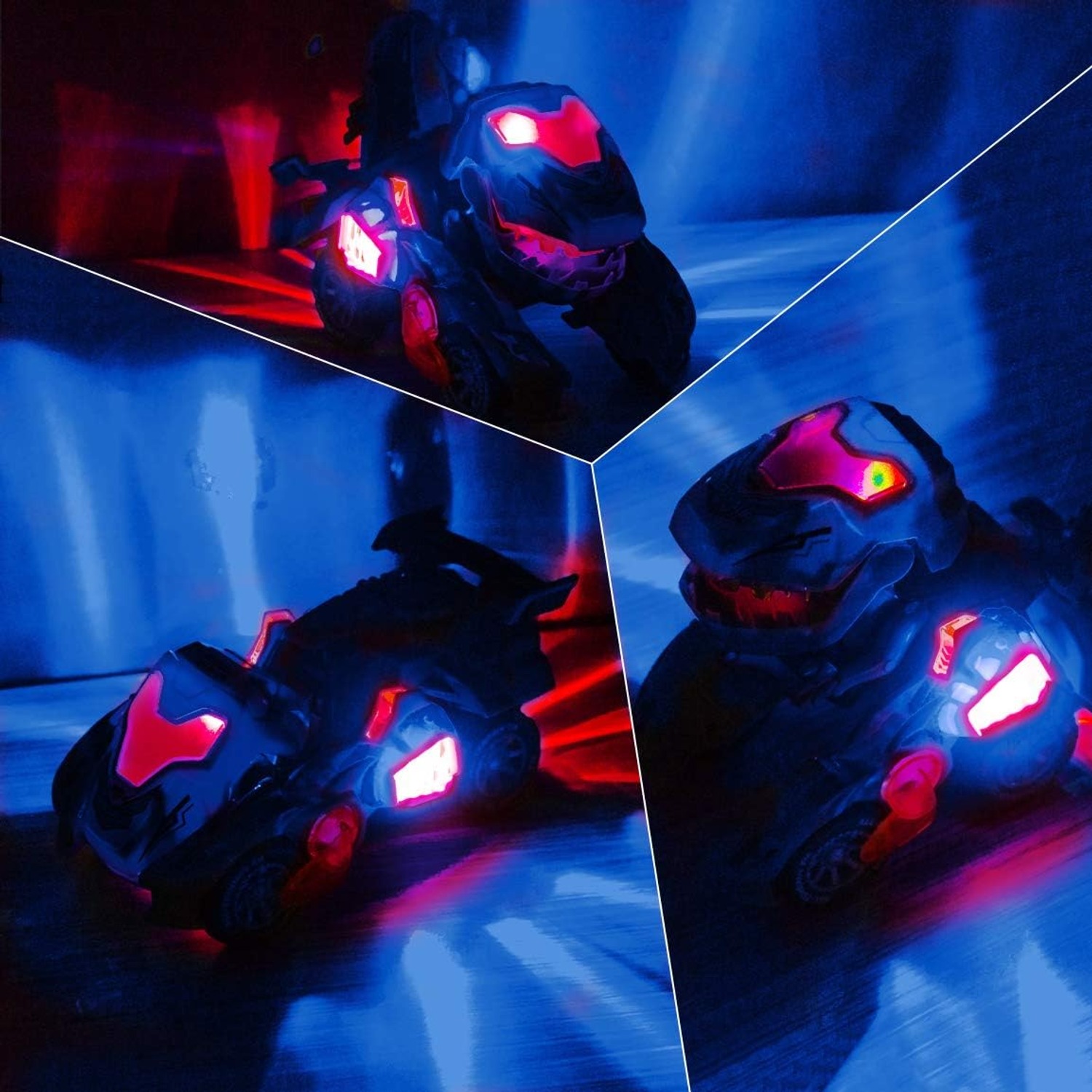
Then there are the lights and the sound. LEDs glow from multiple points on the shell, and the headlights pulse along with the music. The audio is a mix of dinosaur roars and music rather than one looping tune, which keeps it tolerable for the adults in the room. In a bright living room the lights are a nice extra. In a dim hallway at bedtime, they are the main event.
One setup note that catches people out. Toys with universal wheels ship with small protective covers on them to stop damage in transit. Take those off before the first run or the toy will sit there lighting up and going nowhere. It takes two seconds once you know.
Who it suits
The recommended age is 36 months to 8 years, and that is a fair range. At the younger end, a child enjoys the spectacle. They chase it, they pick it up, they want it turned on again. At the older end, the toy becomes a character. It gets a name, it gets a garage made from books, it goes on missions across the kitchen floor.
It suits households with hard floors best. Wood, laminate, tile and vinyl all let the wheels do their job. Short pile carpet works fine. Thick shaggy rugs do not, and the toy can stall halfway through a transformation if the surface is too soft. If your home is deep carpet throughout, this is still playable, but you may want to pick one clear area for it.
It also suits families who want a toy that does not need a parent attached to it. If you are looking for something a child can operate alone and enjoy for stretches at a time, an automatic transforming dino car is a sensible choice. If you want a toy that builds patience and fine motor skills, a manual transforming figure that a child folds by hand is a better fit. Both have a place, they just do different jobs.
How to choose between dinosaur toys
There are a lot of dinosaur toys out there, and they fall into a few groups.
Static figures are the cheapest and the most durable. They never run out of battery and they are great for imaginative play, but they do nothing on their own. Walking dinosaurs move but do not change shape, and they often need more space than a living room offers. Remote control dinosaurs give the most control but need a child old enough to handle a controller, and the remote always goes missing. Transforming models, like this one, sit in the middle. They are active, they are automatic, and the change gives them a trick that the others do not have.
When you are comparing transforming models specifically, a few things matter.
Whether the transformation is automatic or manual. Automatic means it happens during play with no input. Manual means a child folds it themselves. For under fives, automatic is almost always the better pick.
Battery type and count. This one takes three AA cells, which are easy to find anywhere. Toys that use odd button cells or built-in rechargeable packs can be a headache later.
Build material. Plastic with a tough shell handles drops, which is realistic for this age group. Thin, light plastic cracks at the first fall from a kitchen table.
Size. At 13 x 11 x 21 cm and 0.34 kg, this one is easy for a small child to carry and does not take over a shelf.
Getting the most from it
Set it up properly the first time and you avoid most of the complaints people have with this type of toy.
Use fresh alkaline batteries. Weak cells are the single biggest cause of a toy that lights up but will not drive or will not finish a transformation. If performance drops off suddenly, change the batteries before you assume anything is broken.
Clear a run. Lift cables, shoes and loose toys off the floor. The wheels will turn away from a wall, but a phone charger cable will wrap around an axle.
Try it in a dark room at least once. The 3D LED lights are much more impressive without competing light, and it turns an ordinary toy into something children want to show people.
Keep it indoors and dry. Sand and grit get into universal wheels and stay there. Water gets into the electronics and ends the toy.
Looking after it
The care is straightforward. Wipe the shell with a soft cloth that is barely damp, then dry it. Do not run it under a tap or soak it, because there is no seal protecting the inside. For dust around the wheel housings and the joints where it folds, a dry brush or an old toothbrush works better than a cloth.
Check the wheels now and then. Hair and carpet fibres wind around the axles on every floor toy ever made, and clearing them takes a minute and restores full speed.
If the toy is going into storage, take the batteries out first. Cells left in a toy for months can leak and corrode the contacts, which is a common and completely avoidable way for a working toy to die in a cupboard.
Store it at room temperature indoors. Garages and sheds get cold and damp, and neither does plastic or electronics any favours.
As a gift
This is a good gift for one specific reason. The reveal is built in. A child opens the box and sees a car. Thirty seconds later it is a dinosaur. You do not need to explain anything or sell it to them, the toy sells itself in the first minute.
The one thing to remember is that the three AA batteries are not included. Buy a pack when you buy the toy and tape it to the box. A gift that cannot be used on the day it is opened is a small disappointment that is easy to avoid.
The short version
If you want a dinosaur toy that does something on its own, this is a solid pick. It drives, it changes shape, it lights up and roars, and it keeps going without a remote or a parent crouched on the floor. Three AA batteries run it, nothing needs building, and the plastic shell is made to survive being dropped.
It works best on hard floors and short carpet, it is aimed at ages three to eight, and it is at its most impressive with the lights down. Buy batteries at the same time, pull the covers off the wheels before the first run, and keep it away from water and sand. Do those three things and you have a toy that earns its space in the toy box.